Maze Game Education for Kids 1 Graphics and Illustrations
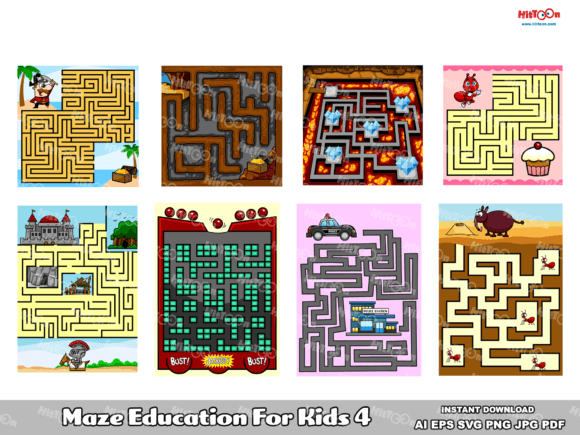
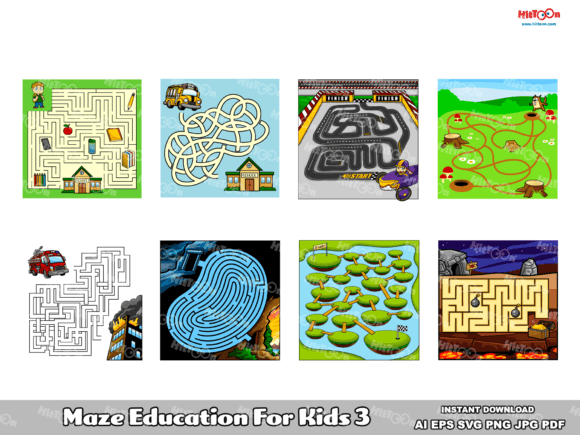
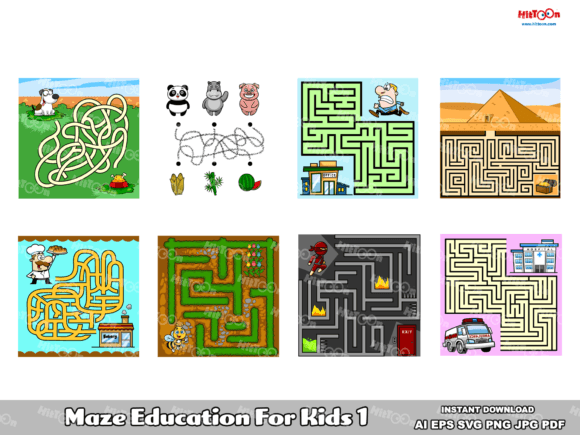
When I first opened the Maze Game Education for Kids 1 bundle, I was immediately struck by how thoughtfully each maze was drawn. The hand-drawn clip art vector illustrations have a playful, organic feel that doesn't look stiff or overly digital. There is a warmth here that reminds me of the activity sheets I used to create for my own children's playdates, but refined enough to use in a professional handmade product. The set includes eight distinct maze designs, all delivered in AI, EPS, SVG, PNG, and JPG formats, which means I can move from my laptop straight to my Cricut or Silhouette without reformatting. For crafters who sell on Etsy or at local craft fairs, this kind of flexibility saves hours of prep time.
The mood of this bundle is cheerful, curious, and slightly whimsical. Each maze path twists through a miniature world of friendly obstacles and playful dead ends. The illustrations feel like they were drawn by someone who understands how kids think, which makes them ideal for any handmade business targeting parents, teachers, or party planners. If you are building a collection of children's products, this graphic design asset brings a consistent, handmade aesthetic that buyers recognize as special. It is not overly cute or saccharine, but it is definitely inviting and engaging. I can see it appealing to customers who want educational toys, quiet-time activities, or screen-free entertainment for their children.
A Real Handmade Business Scenario with Maze Game Education for Kids 1
Let me set a scene that might feel familiar if you run a small handmade business. Imagine you are preparing a batch of custom products for an upcoming craft fair and you also want to refresh your Etsy product listings with something fresh. You have a stack of blank tote bags, a pile of white mugs ready for sublimation, and a roll of printable vinyl waiting for your next sticker sheet. You need a design that works across all these surfaces and appeals to parents who are looking for meaningful, educational gifts. That is exactly where Maze Game Education for Kids 1 steps in. I have used it to create a set of reusable activity placemats, a series of laminated maze cards for restaurant outings, and even a small batch of wooden coaster sets with maze paths engraved into the surface. Each product looked cohesive because the illustration style is consistent across all eight mazes.
For my Etsy shop, I turned this bundle into a digital product listing of printable maze worksheets. I added a cover page with a clean layout, included a thank-you card with a smaller maze on the back, and offered the set as an instant download. The response from customers was immediate. Parents appreciated that the mazes were not too easy and not too hard, and several buyers mentioned using them as party favors for birthday goodie bags. That is the kind of versatility that makes a design bundle worth purchasing. I have also used individual maze designs on t-shirt design projects for a local children's museum gift shop, and the hand-drawn quality translated beautifully onto fabric using heat-transfer vinyl.
Where This Asset Shines in Real Crafting Projects
After working with Maze Game Education for Kids 1 across multiple projects, I have a clear sense of where it performs best and where it needs a little extra attention. Let me walk through the applications that gave me the most success.
Cricut and Silhouette Projects for Educational Products
The SVG design files in this bundle are clean and well-constructed. I imported them directly into Cricut Design Space and Silhouette Studio without any missing lines or broken paths. The maze paths are thick enough to cut smoothly on standard vinyl, and the outer borders are clearly defined, which makes weeding straightforward. I created a set of reusable sticker sheets for a busy mom who wanted her kids to practice mazes on a dry-erase surface. I cut the mazes from printable vinyl, laminated them, and added a small dry-erase marker. The PNG design files with transparent backgrounds were also helpful for quick mockups, especially when I wanted to show customers how the maze would look on a tumbler wrap or a mug design.
Printable Designs for Party Kits and Classroom Activities
For printable products, the illustrations in this bundle shine. The hand-drawn clip art looks charming when printed on cardstock or matte paper. I used the set to create a printable party kit for a dinosaur-themed birthday party. I printed the mazes on A4 paper, added a colorful border, and bundled them with matching activity sheets. The commercial design license allowed me to sell these kits as a physical product, and I also offered a digital version for customers who wanted to print at home. The commercial use rights are clearly stated in the bundle, which is essential for any small business branding effort. I recommend always checking the license file, but in this case, the permissions are straightforward and generous.
Sublimation and Print-on-Demand Products
I tested the sublimation design potential of this bundle on a polyester tote bag and a ceramic mug. The resolution of the PNG files is high enough for 300 DPI printing, and the maze lines stayed crisp after pressing. For print-on-demand platforms like Printful or Printify, I uploaded the maze designs as layered files and added a solid background color to make the paths pop. The mazes that featured more open space and fewer tight turns worked best for sublimation, because the heat press can sometimes blur very fine details. I also used the clipart as a standalone accent on a t-shirt design for a children's bookstore, placing a single maze in the center of the shirt with the store logo above it. The result was professional and marketable.
Where to Use Maze Game Education for Kids 1 with Care
No graphic design asset is perfect for every situation, and I have learned a few lessons while working with this bundle that I want to share with you. The maze designs are generally well-suited for medium to large projects, but they require some adjustments when you scale them down.
Small Sticker Sizes and Thin Details
When I tried to create small sticker sheets with individual maze designs measuring two inches or less, some of the thinner pathway lines became difficult to weed and read. The hand-drawn nature of the vector illustrations means that line thickness varies slightly throughout each maze, which is part of the charm at larger sizes, but at very small scales it can create confusion. For sticker design projects where the final sticker is smaller than a business card, I recommend simplifying the maze by removing some of the inner dead ends or increasing the stroke weight before cutting. I also found that dark-colored vinyl or paper helps the maze stand out, because the white spaces between the lines become more visible.
Layered Vinyl Projects with Multiple Colors
If you are planning a layered vinyl project with several colors, be aware that the maze paths are interconnected and do not naturally separate into distinct layers. I attempted a three-color t-shirt design where I wanted the maze background to be one color, the pathway to be another, and the start and finish markers to be a third. That required manually separating the layers in my design software, which took extra time. The bundle does not include pre-separated layers, so you will need to do that work yourself if you want a multi-color look. For single-color cuts or simple two-color designs, the files work beautifully as-is.
Low-Contrast Color Combinations
Because the maze lines are hand-drawn with subtle variations in thickness, low-contrast color combinations can make the path difficult to follow. I tested a light gray maze on a white mug and quickly realized that the lines were too faint for young children to see clearly. For printable design projects, I recommend using a dark ink color on a light background, or a bright color on a neutral background. The PNG design files come with transparent backgrounds, which is helpful for layering, but you will want to add a solid backing if you are printing on a transparent or translucent material.
Practical Crafter Notes for Using This Bundle
Over the past few weeks, I have developed a checklist that I use every time I work with a new design asset like this one. These steps have saved me from wasted materials and unhappy customers, and I hope they help you as well.
- Test the file before selling finished products. Cut or print a single sample of each maze design before you commit to a large batch. I learned this the hard way when one of the mazes had a tiny gap in the path that made it unsolvable. I was able to fix it in my vector software, but I caught it only because I tested first.
- Check if SVG lines are clean. Open each SVG in your preferred design software and zoom in on the intersections. Look for overlapping nodes or stray points that could cause cutting errors. In this bundle, most files were clean, but I did find one maze where a dead end had a tiny loop that needed to be removed.
- Preview PNG transparency. The PNG files in this bundle have transparent backgrounds, which is excellent for product mockup work. But I always double-check that the transparency is fully opaque around the edges, especially if I plan to use the design on a dark-colored product.
- Confirm resolution for sublimation. For sublimation, I recommend using the PNG files at 300 DPI and scaling them to fit your product without enlarging beyond 150 percent. The vector files are resolution-independent, so they are a safer choice for large tumbler wrap designs.
- Test colors before printing. The maze designs look different on screen than they do on paper or fabric. I always run a color test on my printer or heat press before producing a final product. This is especially important for print-on-demand products where you cannot inspect the physical item before it ships.
- Check how it looks on white and dark products. A maze that looks crisp on a white tote bag may disappear on a black one. I test each design on both light and dark backgrounds to see if I need to add a white underlayer or adjust the colors.
- Place it on real mockups. I use product mockup templates to see how the maze will look on a finished item. This helps me decide whether to center the design, repeat it in a pattern, or use it as a small accent.
- Resize for different products. A maze that works perfectly on a 12-inch tote bag may look too small on a 4-inch notebook. I resize each design to fit the product dimensions while keeping the path widths readable.
- Simplify the layout if needed. For very small products, I sometimes remove a few of the inner dead ends to make the maze easier to cut and read. The bundle includes eight mazes, so I have plenty of options to choose from.
- Pair it with a complementary font. The playful hand-drawn style of these mazes pairs well with a rounded sans serif font or a friendly handwritten font. I avoid formal serif font styles because they clash with the casual mood. A script font can work for titles, but keep it simple so the maze remains the focal point.
- Confirm commercial licensing. Before I use any design asset for customer orders, I read the license file carefully. This bundle is clearly marked for commercial use, which means I can sell finished products featuring the mazes. I always keep a copy of the license in my business files for reference.
Building a Handmade Product Collection with Maze Game Education for Kids 1
One of the reasons I keep returning to this graphic design asset is that it helps me build a cohesive product line without spending hours on original illustration. I have used the eight mazes to create a matching set of products that sell well together: a mug design with a single maze, a set of four greeting cards each featuring a different maze, a sticker design sheet with mini mazes, and a tote bag with a large maze on the front. Customers who buy one item often come back for the others because they recognize the consistent style. That is the power of a well-designed design bundle that is built for real crafting use.
For small business branding, I have also incorporated a single maze into my shop's children's section logo. The maze path leads to a star, which I placed at the center of the design. I used the vector illustrations from the bundle as a starting point and modified the path slightly to create a custom logo that feels unique to my brand. The commercial license allows for modifications like this, which is a huge advantage for creative marketplace sellers who want to stand out.
Final Thoughts on Using Maze Game Education for Kids 1 in Your Craft Business
If you are a handmade business owner looking for a reliable, attractive, and versatile graphic design asset for children's products, Maze Game Education for Kids 1 is a solid choice. The hand-drawn clip art vector illustrations offer a warmth that is hard to find in mass-produced clipart, and the variety of formats makes it easy to use across Cricut projects, Silhouette projects, printable products, and sublimation designs. The eight mazes give you enough variety to create a full product line, and the commercial license gives you the freedom to sell your finished work.
That said, this bundle works best when you take the time to test each file, adjust for scale, and pair it with thoughtful product presentation. The maze designs are not plug-and-play for every possible application, especially very small stickers or complex layered vinyl projects. But with a little preparation, they can become a cornerstone of your children's product offerings. I have already added this bundle to my permanent design library, and I expect to use it for many seasons to come. Whether you are preparing for a craft fair, updating your Etsy product listings, or designing a new collection for your print-on-demand shop, these mazes deserve a close look.